Court of Appeal confirms the operation of prescriptive easements in Victoria

In Les Denny v Delma Valmorbida [2025] VSCA 319, the Court of Appeal upheld the decision of Justice Gorton in Delma Valmorbida v Les Denny [2023] VSC 680, to confirm the operation of easements by prescription in Victoria (or rights of long user).

The Court of Appeal concluded that at general law, an easement can arise based on 20 or more years of use, despite changes in ownership of the relevant land during the period of use.

Further, it held that:

  • section 42(2) of the Transfer of Land Act 1958 (Vic) creates a number of exceptions to indefeasibility in respect of several ‘paramount interests’, including unregistered easements ‘howsoever acquired’.
  • while there is an obvious tension between the policy of certainty of registered title and the express preservation of certain unregistered interests in land, the legislative history strongly supports a conclusion that the legislature has deliberately chosen to allow prescriptive easements acquired by long use as an exception to indefeasibility of title under the Transfer of Land Act; and
  • unless and until Parliament amends the Transfer of Land Act to limit or remove the exception for unregistered easements in s 42(2)(d), the Court must give effect to the exception, despite the potential for it to operate unfairly.

See Les Denny v Delma Valmorbida [2025] VSCA 319:

Supreme Court explains when acquiescence is established in the event of a breach of a restrictive covenant

The Supreme Court has allowed the variation of a restrictive covenant in Lysterfield notwithstanding that the impacts of a new dwelling built in breach of the restriction would be “intrusive and oppressive.”

The Court found that the beneficiaries’ failure to act decisively when visited with the scale of the breach of the covenant was inexplicable.

“207 Even more baffling was the Perrys’ failure to make any further protest, or take any further action once they returned from Darwin in late September 2024. By this time, that the new dwelling breached the height restriction was unmistakeable. No further information was required for them to reach that conclusion. The roof sheeting had been installed, such that what was observed during the course of the view was visible to anyone from sometime in August 2024, and by the Perrys themselves from 29 September 2024. The construction of the new dwelling was advancing at some pace. But the Perrys took no steps to halt the construction of the new dwelling until five months after their return from Darwin.”

The Court found that this conduct amounted to acquiescence for the purposes of s84(1)(b) of the Property Law Act 1958 (Vic) and agreed to modify the covenant to allow the new dwelling and its pitched roof notwithstanding that that new dwelling would substantially impair the views from the Perrys’ living/dining room.

Before and after photos are at pages 4 and 14 in Jayasinghe v Perry [2025] VSC 751, below:

Planning reforms to overhaul Victoria’s law on restrictive covenants

The Victorian Government has released the Planning Amendment (Better Decisions Made Faster) Bill 2025.

The proposed changes contain two significant changes to the regulation of restrictive covenants in Victoria.

FIRST, it is proposed that planning policy can be considered in the decision to remove or vary a restrictive covenant. The new section 60(2) will provide:

“Before deciding on a type 2 or 3 application which would allow the removal or variation of a restriction (within the meaning of the Subdivision Act 1988), the responsible authority must also consider the following—
(a) the impact of removing or varying the restriction on the material interests of the owner of any land benefited by the restriction (other than an owner who, before or after the making of the application for the permit but not more than 3 months before its making, has consented in writing to the grant of the
permit) in terms of—
(i) loss of amenity; and
(ii) loss arising from change of character to the neighbourhood; and
(iii) any other material detriment, other than financial loss, that may be suffered;
(b) the impact of the restriction on the ability to deliver—
(i) the objectives of planning in Victoria; and
(ii) any applicable State planning strategy, regional planning strategy or planning strategy for the area covered by the planning scheme; and
(iii) the objectives or purposes of the planning scheme;
(c) whether a matter that is the subject of the restriction to be removed or varied is also regulated by the planning scheme;
(d) if the removal or variation of the restriction is proposed in conjunction with an application for a permit for a use or development that would breach the restriction, for the purpose of considering a matter under paragraph (a), (b) or (c), whether that use or development is acceptable having regard to the matters set out in subsections (1), (1AA), (1A) and (1B) 15 (if relevant).

The current wording of section 60(2) requires that the impacts on beneficiaries be resolved before planning policy can be considered. As Senior Member Wright QC explained in Waterfront Place Pty Ltd v Port Phillip CC [2014] VCAT 1558: “72. The Tribunal stated that in applying the tests set out in s. 60(2) it is not a question of balancing the loss suffered by a benefiting owner in each of the categories set out in paragraphs (a) to (d) against the planning benefits of removal or variation of the covenant. The tests must be applied in absolute terms. Consideration of the planning merits can occur only if the tests are satisfied and the discretion to grant a permit thereby enlivened. This Tribunal respectfully agrees.”

Section 60(5) is also proposed to be repealed. The existing section 60(5) of the Planning and Environment Act 1987 has been described as “a high barrier that prevents a large proportion of proposals”:

(5) The responsible authority must not grant a permit which allows the removal or variation of a restriction referred to in subsection (4) unless it is satisfied that—
(a) the owner of any land benefited by the restriction (other than an owner who, before or after the making of the application for the permit but not more than three months before its making, has consented in writing to the grant of the permit) will be unlikely to suffer any detriment of any kind (including any perceived detriment) as a consequence of the removal or variation of the restriction; and
(b) if that owner has objected to the grant of the permit, the objection is vexatious or not made in good faith.

Without any exaggeration, this provision means that someone could argue that the proposed modification or discharge of a covenant would make the beneficiaries’ curtains fade, and the decision maker would have to refuse the application. It has never been clear why this incredibly strict standard applies to pre-1991 covenants and a less strict standard applies to post 1991 covenants. In any event, this distinction is proposed to be brought to an end in the new Bill, as all covenants are proposed to be covered by the new s60(2), above.

SECOND, the Minister or responsible authority would be able to grant a planning permit that will breach a restrictive covenant. This removes a considerable burden from local councils that presently need to regularly seek legal advice on the proper construction of covenants to avoid granting a permit that may breach a restrictive covenant. As one senior government lawyer explained: “Councils are presently the gate keepers and arbiters of the private property law system. It’s incredibly unfair and generates an inordinate amount of work.”

But the covenants themselves will remain fully enforceable until they are removed or varied. This may lead to an increase in the number of injunction applications as people try to act on a planning permit and simply wait for one or more beneficiaries to stop them. The risks in doing so are high.

Prior to 2000, planning permits could be granted that would permit a breach of a restrictive covenant. For instance, in Luxury Developments v Banyule CC [1998] VCAT 1310 the Tribunal explained that its remit was exclusively the application of town planning controls and policies. It had no jurisdiction to consider the proprietary legal interests raised by the existence of a restrictive covenant. However, after the permit was granted and construction commenced, the residents of the Hartland Estate in Ivanhoe sought and were granted an injunction in the Supreme Court of Victoria to stop the development.

Luxury Developments subsequently went into liquidation, leaving the residents of the Hartlands Estate unable to recover their costs. Partly in response to this case, the Victorian Parliament passed the Planning and Environment (Restrictive Covenants) Act 2000, an Act that would prevent planning permits from being issued where they would breach a restrictive covenant. The proposed amendment will reverse the effect of that change to the Planning and Environment Act 1987.

IN CONCLUSION, the Supreme Court process may remain the preferred choice of jurisdiction for a number of restrictive covenant applications, such as: uncontroversial applications; applications for declarations; and applications not supported by state policy (such as an application to increase the height or number of storeys of a single dwelling)–appreciating that the Supreme Court tends to be much faster and ultimately less expensive than VCAT (and one that doesn’t ordinarily involve council planners or solicitors).

But for ambitious changes to restrictive covenants where multiple dwellings are proposed over the objections of beneficiaries, it may be that the new process creates a regulatory framework in which planning policy is given significant weight in a decision to amend or discharge a restrictive covenant. An example of this might be land along Wattletree Road in Malvern, where policy supports more intensive forms of development but development is constrained by the presence of numerous single dwelling covenants. Presently, an application for planning permit for a medium density housing would likely fail if it was opposed by beneficiaries of the single dwelling covenants, but subject to satisyfing questions of neighbourhood character, that may be about to change.

The new laws may not come into effect until 2028, assuming they pass both houses of the Victorian Parliament without significant amendments.

A more detailed analysis of the Bill can be found here in the consolidated notes, under ‘Attempts at Reform’.


[1]              Fitt & Anor v Luxury Development Pty Ltd [2000] VSC 258.

The Supreme Court will generally discharge covenants that fail to identify benefiting land without notice

The Court is routinely invited to declare restrictive covenants unenforceable on the grounds that no land is identified as benefiting from a restriction, and it will generally do so without any form of public or private notice:

  • in Re Pomroy S ECI 2021 03444 Matthews AsJ (as she then was) discharged a restrictive covenant on the grounds that “The restrictive covenant contained in Instrument of Transfer No. 1159026 in the Register kept by the Registrar of Titles under the Transfer of Land Act 1958 (Vic) is not enforceable by any persons other than the Transferors named in the said Instrument of Transfer”;
  • in Re Antony & Sunita S ECI 2023 03873 Ierodiaconou AsJ concluded that the Covenant was invalidly registered, as it “failed to identify any land as taking its benefit”. It followed that: “The Covenant should be discharged because of there being no substantial injury to any person entitled to its benefit”; and
  • in Re Burton S ECI 2024 02915, Daly AsJ discharged a restrictive covenant on the grounds that “The Court is satisfied that the covenant is invalidly registered, as it fails to identify any land as taking its benefit. The covenant should be discharged because of there being no substantial injury to any person entitled to its benefit.”

No form of notice was required in any of these applications.

A vivid example of why you should not apply to VCAT to modify or discharge a covenant

In Mirams v Boroondara CC [2022] VCAT 928, the Tribunal considered an application for planning permit to remove a restrictive covenant from a title to land in the Grace Park Estate. Following the provision of notice, a practice day hearing was held, followed by a preliminary hearing at which the permit applicant was represented by a QC, Council and three objectors were represented by solicitors and two parties were represented by lay advocates.

In contrast, a similar application was considered by the Supreme Court in Re Moolman in S ECI 2025 4277. No notice was required and the Court determined the application after brief submissions from counsel.

The wording of the covenants were in all relevant respects identical and the effect similar, namely the discharge of the covenants, but the VCAT proceedings took months and attracted considerable attention, whereas the Supreme Court granted the relief sought without notice and in the space of three weeks from commencement of the application.

Another building materials covenant amended without notice to beneficiaries

The Supreme Court has again amended a building materials covenant without requiring notice to beneficiaries. This is appropriate because rarely do beneficiaries object when notice is given of such an application. In this case (as with others), no expert evidence was required and the orders were granted in about three weeks from the application being made. See Re: Besser S ECI 2025 4337.

How to protect against a future purchaser attempting to renegotiate a settled agreement to modify a covenant

To the best of my knowledge there is no settled authority on the question of whether a negotiated agreement to amend a covenant becomes the new comparator or floor, for the determination of substantial injury in section 84(1)(c).

This is of particular significance to parties negotiating an amendment to a covenant prior to the land being sold. In practical terms, beneficiaries are entitled to ask: “what’s to stop the purchaser having another go at this, but using the negotiated agreement as the basis for determining substantial injury under section 84(1)(c) of the Property Law Act 1958?”

This challenge was met with the inclusion of the following words in paragraph H of other matters in Re Natwes in the draft consent terms provided for the court’s consideration: “In compromising the proceeding, the parties agree that the modifications set out in this order (Agreed Modifications) will not result in substantial injury but acknowledge that any further modification, however minor, may result in a substantial injury to the beneficiaries having regard to the protections afforded by the Covenants in their original form.”

Should you apply to modify a covenant via the planning permit process if s60(2) of the Planning and Environment Act 1987 applies?

For covenants created on or after 25 June 1991, applicants are often tempted to pursue the modification of covenants through the Planning and Environment Act permit application process on the basis that it is purportedly cheaper than applying through the Supreme Court.

However, this can be a false economy when considering that each beneficiary needs to be notified via the Planning and Environment Act 1987 process and depending on the size of the subdivision that can be expensive. I have had clients complaining that the process of notice can cost $3,000 for small to medium subdivisions to $10,000 for larger subdivisions.

Moreover, the obligations for the production of evidence are no lower in the Tribunal and so the cost of engaging an expert may be greater given that the expert will invariably be required to appear to give evidence at VCAT, whereas a judicial registrar or Associate Judge will typically be content to consider the evidence on the papers.

And that hints at perhaps the critical distinction—that cases in VCAT are more often than not opposed by beneficiaries who bear few if any cost consequences from appearing to oppose an application to modify a restrictive covenant, whereas in the Supreme Court applications to modify restrictive covenants are more often than not, unopposed.

Moreover, Council as the responsible authority will invariably be a party to an application for planning permission, whereas they will only rarely be involved in a section 84 application, for instance, if Council owns nearby parkland that enjoys the benefit of the covenant sought to be modified. Taking that wildcard out the equation alone is of profound assistance to applicants.

The test in section 60(2) of the Planning and Environment Act can also be more narrowly applied than section 84 in the Property Law Act. By way of example, in Ambrosio v Hume CC [2019] VCAT 2049 the Tribunal rejected an application for an additional dwelling at 30 Eucalyptus Ct, Mickleham in the Mt Ridley Estate, whereas the Supreme Court has since approved seven somewhat similar applications in the same precinct.

The network of covenants in the Woodlands Estate, Mt Eliza may be broken

Lots in LP 40704, shown below, have for many years been believed to be the subject of a network of single dwelling restrictive covenants.

The integrity of this network has recently been drawn into question by three decisions of the Supreme Court of Victoria either modifying the single dwelling covenant to allow a second dwelling on the lot, or discharging the covenant completely.

The process for modifying or removing the restrictive covenant on your land might adopt the following course:

  • receipt of advice to confirm that your covenant has similar features to the other applications;
  • the drafting of an Originating Motion to the Supreme Court of Victoria to remove the covenant or modifying it to allow one additional dwelling;
  • the giving of notice of the application, which may consist of putting a sign on the land for four weeks; and
  • upon the consideration of any objections, relief being granted in terms similar to those sought, namely the discharge or modification of the covenant.

In the most recent applications, planning evidence has not been required.

Upon the granting of the relief by the Supreme Court, a planning permit might still be required to subdivide your land to create an additional lot for sale, but it would likely be no longer barred by s61(4) of the Planning and Environment Act 1987.

Some exemptions from planning laws might apply, for instance, for the construction of a small second dwelling.

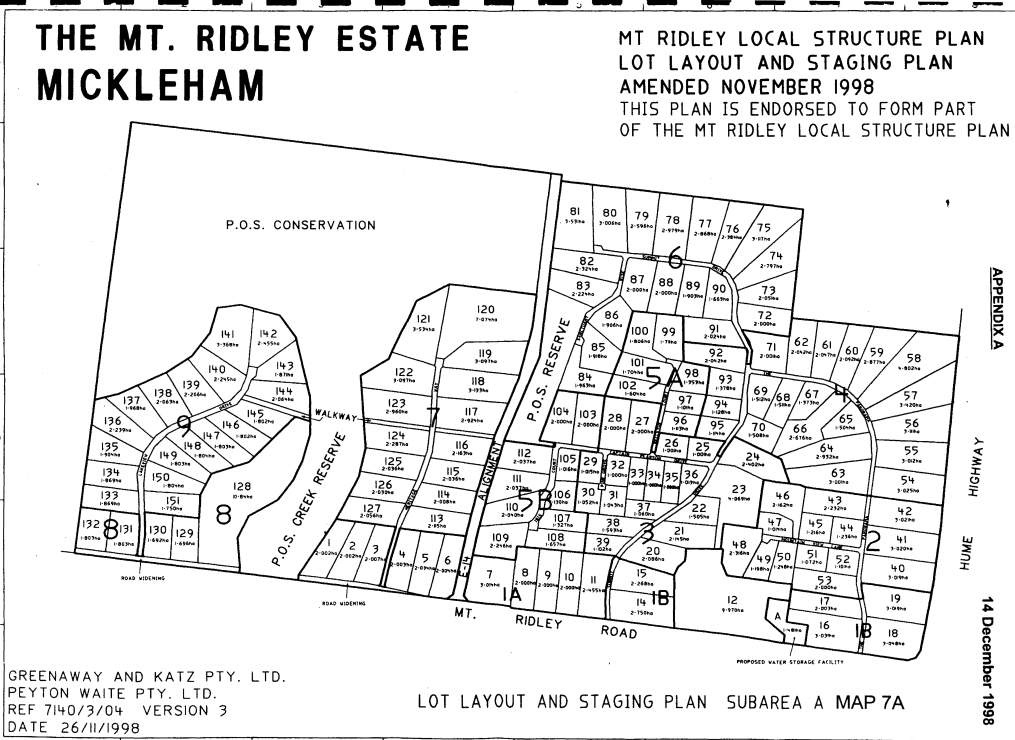
The Supreme Court makes a further modification to the covenants in the Mt Ridley Estate in Mickleham

On 17 June 2025, in Re Kaur S ECI 2025 01364 the Supreme Court made a further modification to the network of restrictive covenants in the Mt Ridley Estate, Mickleham, shown below:

That takes the number of titles modified to allow an additional one or two dwellings, to six or more in recent years. We are now finding that most applications proceed unopposed.

And for good reason. Large subdivisions of land such as that in the Mt Ridley Estate incorporate single dwelling covenants often as an assurance to planning authorities that infrastructure will not be overwhelmed by the subdivision and subsequent development of land.

As time passes, and surrounding land is intensively developed, these subdivisions stand as artefacts to infrastructure conditions long gone.

Lots remain sufficiently large for further subdivision to occur without noticeably impacting on the amenity of neighbouring beneficiaries and the Supreme Court seems increasingly comfortable in approving applications to vary these covenants.

Significantly, the experience has been quite different for those people who apply via the permit application process, with an application in Ambrosio v Hume CC [2019] VCAT 2049 being refused on the basis that the grant of a permit could result in amenity or character loss through the creation of a differently shaped lot.

The Supreme Court, however, has been flexible in the creation of regular lots and battle axe allotments to work around existing dwellings.